Today, thanks to the infinite possibilities of the online world, it’s no surprise that it can often feel as though our world is spinning faster than ever.
We are burdened with the psychological weight of carrying a million opinions, ideas and hacks in our small, electronic devices. Opening our phones can quickly send us into a doom-scroll that catapults us from learning how to achieve the best Sunday roast, to observing a couple enjoying a meal in Paris against a backdrop of riots and buildings ablaze – all in the space of a few seconds.
Whilst our social media can keep us connected and attached to our the current trends, affairs and political discourse, it also does a great job of subtly contributing to self-sabotage, ultimately hindering personal growth and success.
In this article, we explore the nature of self-sabotage, its underlying causes, and offer practical strategies to help you increase self-awareness and overcome its negative impact.
Self-sabotage is the subconscious act of hindering one’s own progress and well-being. It can manifest in a multitude of ways including procrastination, negative self-talk, perfectionism, self-doubt and the fear of failure. Although the reasons behind self-sabotage may vary from person to person, it is often rooted in deep-seated beliefs of unworthiness, fear of success, or a desire to maintain the familiar, even if it is detrimental.
This complex behaviour can arise from many different factors. It might be that you have experienced past trauma, criticism, or failure – these can create a fear of repeating those painful moments and in an attempt to protect yourself from this happening again, it might be that you are unconsciously sabotaging your own efforts. It’s also important to mention that societal pressures, comparison to others, and the fear of judgement can contribute to self-sabotage by creating unrealistic expectations and feelings of inadequacy.
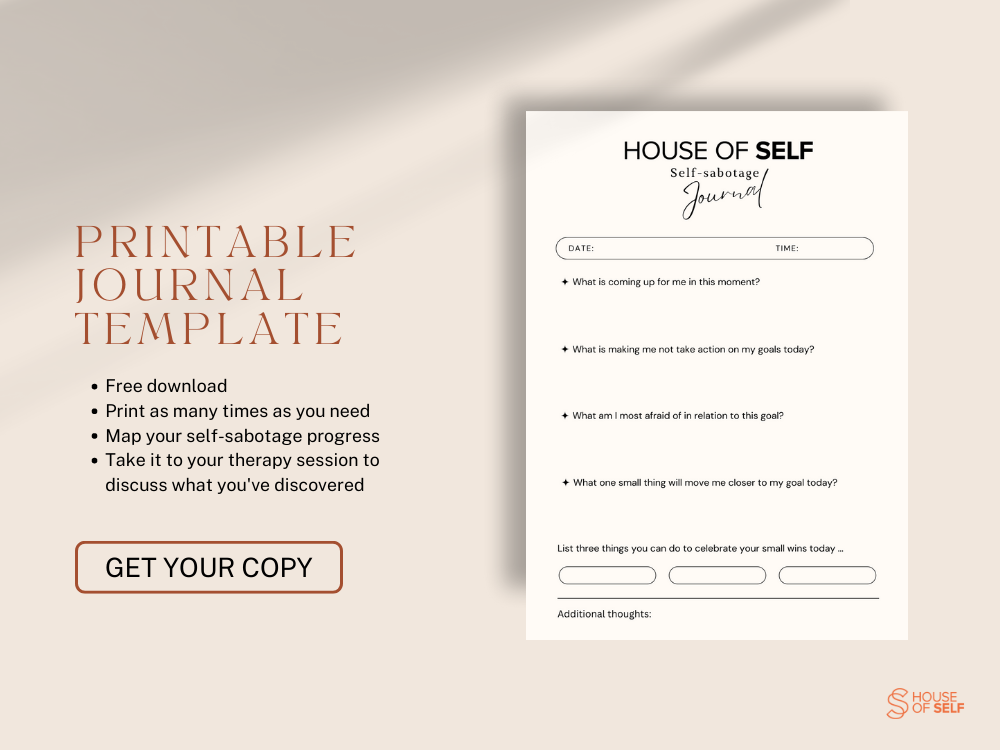
Increasing self-awareness can enable us to spot the signs of self-sabotage and can be one of the first steps toward breaking free from its grip. Try to pay attention to recurring patterns of behaviour or any negative thought patterns that arise for you when you’re working towards your goals. Journaling is a wonderful, accessible way for you to take note of this – start to take note of the times you are aware of self-sabotage creeping in.
Here are some journal prompts that might help you log moments of self-sabotage:
The journey to overcoming self-sabotaging behaviours isn’t easy but it’s also not impossible. Don’t be afraid to reach out to your family, friends or professionals for guidance and support. By increasing your self-awareness, challenging negative thought patterns, and implementing strategies for growth, you can reclaim your power and build a more fulfilling and successful life. Remember, the path to self-empowerment starts with acknowledging and addressing self-sabotage head-on. So, what are you waiting for?